The Ultimate B2B Guide to Land Rover Intercoolers: Charge-Air Cooling, Reliability, Fitment, and Wholesale Sourcing
The lede: An intercooler is the heat exchanger that manages the temperature of compressed intake air after it leaves a turbocharger or supercharger and before it reaches the engine. For a Land Rover workshop, importer, or distributor, the component is not simply a large aluminium box. It is part of a calibrated charge-air system in which cooling capacity, pressure drop, airflow, sealing, hose routing, mounting strength, and engine fitment all influence the final result.
This guide explains how an Intercooler works, why cooler charge air can support efficient combustion, how air-to-air and air-to-water designs differ, which symptoms can indicate a boost leak or damaged cooler, how technicians should diagnose the system, and how B2B buyers can source dependable Land Rover replacement parts. PERFECTRAIL is described only through information published on its public website: Land Rover specialization, OEM and aftermarket replacement parts, product consultation, inventory, low MOQ, global delivery, OEM/ODM assistance, supplier evaluation, product inspection, and after-sales support. Exact intercooler availability, fitment, warranty scope, and commercial terms must be confirmed for each enquiry.
1. Global B2B Market Opportunity for Land Rover Intercoolers
The Land Rover aftermarket includes turbocharged diesel and petrol applications, multiple generations, different body packages, and vehicles operating in very different climates. Some vehicles are maintained by dealer networks, while others are supported by independent workshops, fleet operators, exporters, and specialist distributors. This creates continuing demand for charge-air components. An Intercooler can remain hidden behind a bumper or within an engine bay, but its condition directly affects how much compressed air reaches the engine and how consistently the powertrain performs under load.
For a B2B purchaser, the commercial importance of an intercooler is greater than its visible size suggests. A correct replacement can restore boost control, reduce workshop diagnostic time, and help a repairer return a vehicle to service. An incorrect or poorly sealed part can cause repeated boost leaks, low power, unusual noise, warning lights, customer complaints, and additional freight. A cooler that fits the mounting points but has the wrong inlet, outlet, core depth, or pressure behavior may create installation delays or compromise the charge-air system.
Intercooler demand is also connected to surrounding components. A replacement may be ordered with charge-air hoses, clamps, O-rings, brackets, intake pipes, turbocharger parts, air filters, sensors, gaskets, and cooling-system components. When a turbocharger fails, the intercooler may need a detailed inspection for oil or metal contamination. A supplier that helps a workshop identify the complete repair scope can improve order accuracy while reducing the risk that a new cooler is installed into a contaminated or leaking system.
Why intercooler sourcing is a technical purchase
The intercooler must perform two jobs at the same time: transfer heat away from the compressed air and contain the boost pressure without leaking. Its core, tanks, seams, mounting points, hose connections, and internal passages all matter. A larger core is not automatically better if it creates excessive pressure drop, blocks radiator airflow, increases pipe volume, or cannot be mounted correctly. A smaller cooler is not automatically wrong if the original engine and operating conditions were designed around that package. The correct decision is application-specific.
A strong SEO page should serve both information and commercial intent. A workshop may search “what does an intercooler do,” “intercooler boost leak symptoms,” or “air-to-air versus air-to-water intercooler.” A procurement manager may search “Land Rover intercooler supplier,” “aftermarket intercooler wholesale,” “charge air cooler replacement,” or “intercooler OE cross reference.” The page should answer the technical question first, then guide the reader toward fitment confirmation and a quotation.
PERFECTRAIL’s relevant B2B positioning
PERFECTRAIL’s public website presents the company as a Land Rover parts specialist supplying OEM and aftermarket components for Defender, Range Rover, Discovery, and Freelander applications. Public business information highlights product consultation, stock, low MOQ, global delivery, OEM/ODM support, supplier evaluation, product inspection, and after-sales service. These capabilities are relevant to intercooler buyers because the category requires model and engine verification, technical communication, careful packaging, and practical replenishment support.
B2B takeaway: Position a Land Rover Intercooler as a pressure-containing heat exchanger and a fitment-sensitive engine component. The strongest offer combines verified application data, pressure and leak information, robust packaging, sensible MOQ support, and a transparent warranty process.
2. How an Intercooler Works
A turbocharger or supercharger compresses intake air so that more oxygen can be delivered to the engine. Compression increases pressure, but it also increases air temperature. Hot charge air occupies more volume and is less dense than cooler air at the same pressure. The intercooler receives this hot, compressed air and transfers heat to another medium, usually ambient air or coolant, before the charge enters the intake manifold or combustion chamber.
Cooling the charge does not create power by itself. It helps the engine control the temperature and density of the air supplied by the forced-induction system. The result can be more consistent combustion, a reduced tendency toward heat-related knock or excessive thermal stress, improved efficiency, and better repeatability under load. The final outcome still depends on turbocharger selection, boost pressure, engine calibration, fuel delivery, exhaust flow, ambient temperature, and installation quality.
The charge-air path
- Air filtration: Ambient air passes through the engine air filter, which protects the compressor and engine from dust and debris.
- Compression: The turbocharger compressor or supercharger raises intake-air pressure, increasing temperature as the air is compressed.
- Charge-air transfer: Pressurized air travels through pipes and hoses toward the intercooler. Every joint must seal against boost pressure.
- Heat exchange: The intercooler transfers heat from the charge air to ambient air or a coolant circuit.
- Intake delivery: Cooler air exits the intercooler and travels to the intake manifold or cylinder head.
- Combustion: The engine control system supplies fuel according to the measured and commanded operating conditions.
Heat transfer through tubes, fins, and tanks
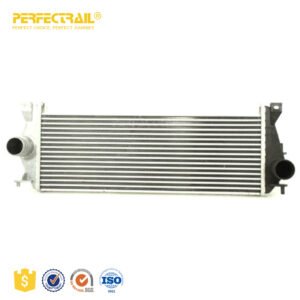
An air-cooled intercooler normally contains an inlet tank, a network of tubes and fins, and an outlet tank. The tubes carry compressed air, while fins increase the external surface available for heat transfer. Air moving through or across the fins carries heat away. The core must balance surface area, internal volume, air velocity, pressure drop, structural strength, and resistance to vibration and corrosion.
The inlet and outlet tanks distribute charge air across the core. Poor internal distribution can leave parts of the core underused, while an abrupt restriction can increase pressure loss. The tank shape, weld or braze quality, hose bead, mounting position, and drain or sensor provisions should match the intended application. This is why a catalogue description should contain more than external length and width.
Temperature, density, and pressure drop
A cooler charge generally has higher density than hotter charge air at the same pressure. This allows the engine to receive more oxygen per unit volume. However, the intercooler also creates resistance to air movement. The design objective is not the lowest possible outlet temperature at any cost; it is an effective balance between cooling and pressure loss across the operating range.
Pressure drop means the pressure at the intercooler outlet is lower than the pressure at the inlet because air must pass through tubes, bends, tanks, and core passages. Excessive pressure drop can make the turbocharger work harder and reduce response. A supplier or engineer should evaluate the complete engine and charge-air system rather than recommending a larger core based on appearance alone.
Technical caution: Cooling performance and airflow resistance must be considered together. A replacement Intercooler should match the original system’s pressure, mounting, pipe routing, and thermal requirements unless a documented engineering change is intended.
3. Intercooler Types, Placement, and System Design
Intercoolers can be classified by the medium used to remove heat, the location in the vehicle, and the shape or internal construction of the core. The most important distinction for a B2B buyer is whether the component is air-to-air or air-to-water. A second distinction is whether the replacement is an original-style part or an engineered upgrade. Both choices affect packaging, pipework, thermal behavior, service, and cost.
Air-to-air intercoolers
An air-to-air intercooler uses ambient airflow to cool the compressed intake air. It is often mounted at the front of the vehicle where airflow is available. The design is relatively direct: charge air passes through internal tubes, while ambient air passes over external fins. There is no separate coolant pump or low-temperature radiator for the charge-air circuit, which can simplify service.
The trade-off is packaging. A front-mounted air-to-air cooler may require longer charge pipes, additional brackets, and ducting. The core may compete with the engine radiator, air-conditioning condenser, grille, or crash structure for airflow and space. Dirt, leaves, bent fins, and a blocked front face can reduce performance. The supplier must confirm the mounting points and airflow position rather than selling a universal-looking core as a direct replacement.
Air-to-water intercoolers
An air-to-water or liquid-to-air system transfers heat from the charge air to coolant. The coolant then moves through a separate low-temperature radiator or heat exchanger. Because the core can be compact and can be positioned close to the intake manifold, the system may reduce charge-air volume and improve packaging. It can also offer more controllable thermal management.
The additional circuit brings more parts: coolant, pump, hoses, reservoir or expansion provisions, low-temperature radiator, sensors, and control strategy. A leak or pump fault can affect charge-air temperature, while air trapped in the coolant circuit can reduce heat transfer. A B2B quotation must make clear whether it includes the core only or the required supporting circuit.
Front-mount, top-mount, and side-mount placement
A front-mount intercooler can receive strong airflow but may need longer pipes and can place additional demand on the front cooling package. A top-mount intercooler can use a shorter charge path, but it may experience heat soak from the engine and depend on a functional hood scoop or duct. A side-mount cooler can fit a constrained package but may have less frontal airflow and a smaller core. The best location is the one designed for the vehicle’s air path, heat sources, boost level, and service environment.
Core design and materials
Core construction can use different tube, fin, tank, and coating designs. Aluminium is common in automotive air-to-air applications because it combines low weight with useful thermal conductivity and corrosion resistance when correctly designed and finished. Plastic or reinforced polymer tanks may be used where they provide the required sealing, heat resistance, weight, and cost balance. The exact material and joining method should match the application.
Tube-and-fin geometry affects heat transfer, airflow, pressure drop, and resistance to vibration. A dense fin pack may increase surface area but become more sensitive to dirt and airflow restriction. An open design may reduce resistance but require more physical volume. A reputable supplier should be able to discuss the intended application and provide dimensional or inspection evidence rather than relying only on a “high-performance” label.
| Intercooler design | Primary advantage | B2B verification point |
|---|---|---|
| Air-to-air | Simple heat-transfer path and no separate coolant circuit | Frontal airflow, core size, pipe length, mounting, pressure drop |
| Air-to-water | Compact packaging and controllable cooling circuit | Coolant pump, radiator, hoses, sensors, bleed and service procedure |
| Front-mount | Strong ambient airflow at vehicle speed | Grille, radiator stack, ducting, brackets, pipe routing |
| Top or side mount | Shorter packaging path or constrained installation space | Heat soak, scoop or ducting, airflow, engine-bay clearance |
4. Land Rover Fitment and Application Verification
The term “Land Rover Intercooler” covers many possible assemblies. Defender, Range Rover, Discovery, and Freelander vehicles have different model generations, engine types, turbocharger configurations, front-end packages, hose arrangements, and market specifications. Even vehicles with the same model name may use different cooler dimensions or inlet and outlet positions. B2B buyers should treat the model name as an initial search term, not final fitment proof.
The minimum fitment record
Request the VIN, engine code, model year, fuel type, OE reference, intercooler location, hose or pipe connection sizes, mounting-hole arrangement, and photographs of the original component. If the vehicle has had a replacement engine, turbocharger, remap, body conversion, accident repair, or previous cooling-system modification, record that information. The registration record may not describe the current charge-air package.
Cross-reference numbers are useful but should be verified against dimensions and application. A number may be superseded, market-specific, or listed by several aftermarket brands with different construction or included fittings. The quotation should identify whether the part is a complete cooler, a core, a cooler with tanks, or a kit with brackets, hoses, clamps, seals, or mounting hardware.
Fitment details that frequently cause returns
- Inlet and outlet location, orientation, bead design, and connection diameter.
- Core length, height, depth, tank shape, and clearance from the radiator or body.
- Mounting brackets, pins, rubber isolators, and fastener positions.
- Air-to-air or air-to-water architecture and any associated pipes or coolant parts.
- Sensor ports, drain provisions, internal baffle design, and hose routing.
- Vehicle market, engine output, emissions configuration, and model-year change.
SEO internal-link strategy
A strong Intercooler page should link to PERFECTRAIL’s Land Rover parts specialist overview, the Defender parts category, the Range Rover parts category, the Discovery parts category, and the contact page. Use descriptive anchor text where it supports the reader’s next decision, rather than adding unrelated links solely for keyword density.
Use careful wording such as “for selected Land Rover applications; confirm by VIN and OE reference.” This language improves trust because it reflects the actual fitment process. Avoid a universal-fit claim unless the supplier has documented that the part applies to every vehicle listed.
5. Intercooler Failure Symptoms and Diagnosis
Intercooler problems often appear as a loss of boost, slow acceleration, or a hissing sound, but the cooler is only one part of the charge-air system. A cracked hose, loose clamp, damaged O-ring, failed pipe, turbocharger problem, sensor fault, blocked air filter, or control issue can create similar symptoms. The correct diagnostic approach checks the complete path from compressor outlet to intake manifold.
Common symptoms associated with intercooler or boost-system faults
- Reduced acceleration: A leak or restriction can prevent the engine from receiving the intended charge pressure.
- Slow boost response: Air escaping from a joint or cooler may delay pressure build-up.
- Hissing or whooshing: Pressurized air escaping from a crack, tank, hose, clamp, or seal can create an audible noise.
- Oily residue: A light oil film can exist in some charge-air systems, but fresh residue around a joint may indicate an air leak. It must be interpreted with the turbocharger and engine condition.
- Higher intake-air temperature: A damaged, blocked, heat-soaked, or poorly ducted cooler may not remove enough heat.
- Warning lights or underboost codes: Control-system faults may be triggered when actual boost differs from commanded boost.
- Visible damage: Dents, cracked welds, bent fins, corrosion, damaged brackets, or distorted hose beads can reduce reliability.
- Excessive smoke or poor combustion: A charge-air fault can affect the air-fuel balance, but fuel, EGR, turbocharger, and engine faults must also be considered.
A professional diagnostic sequence
- Record the operating complaint. Note whether the loss appears at idle, acceleration, high load, high speed, or after the vehicle becomes hot.
- Scan for relevant data. Compare commanded and actual boost, intake-air temperature, airflow, and related fault codes where available.
- Inspect the complete air path. Check the turbo outlet, pipes, hoses, clamps, cooler tanks, mounts, intake connections, and sensor seals.
- Look for contamination. Check for oil accumulation, water, dust, or metal particles, especially after a turbocharger failure.
- Pressure-test the system. Isolate the charge-air circuit and use the approved pressure range. Apply soapy water or another suitable method to locate bubbles or escaping air.
- Use smoke testing when appropriate. Smoke can help find small leaks that are difficult to see, but the test pressure and safety procedure must suit the components.
- Evaluate temperature behavior. Compare inlet and outlet temperatures under controlled conditions and interpret them with ambient temperature and airflow.
- Confirm the repair. Recheck boost, temperatures, noise, codes, and hose security after installation.
Workshop warning: If a turbocharger has failed mechanically and released metal fragments, do not install a new intercooler without inspecting and cleaning the connected pipes, intake path, and engine-side components. Debris can cause further damage after the original repair.
This diagnostic section supports both technical trust and search intent. It answers what a driver or workshop may observe, while clearly stating that a symptom does not prove the intercooler is the only cause. For a B2B sales team, the same sequence becomes a useful request form: ask for fault codes, photos, test readings, and the original part reference before preparing a quotation.
6. How B2B Buyers Should Select a Replacement Intercooler
A dependable purchasing process begins with exact vehicle data and ends with inspection and installation confirmation. Buyers should compare the total cost of a correctly matched cooler with the cost of a part that causes a return, rework, or customer complaint. For a pressure-containing heat exchanger, quality includes core construction, tank sealing, weld or braze integrity, hose interfaces, mounting strength, dimensional accuracy, pressure capability, cleanliness, corrosion resistance, and packaging.
Step one: identify the application
Send the supplier the VIN, model, generation, production year, engine code, fuel type, OE reference, turbocharger configuration, and photos of the original intercooler. Include dimensions when the number is missing or unclear. Explain whether the request is for an original-style replacement, a heavy-duty cooler, a modified vehicle, or a fleet repair. These details help prevent a visually similar but technically incorrect recommendation.
Step two: define the complete supply scope
Clarify whether the price covers the intercooler only or includes tanks, brackets, rubber mounts, hoses, clamps, O-rings, seals, sensor provisions, and installation hardware. If a liquid-to-air system is involved, confirm whether the coolant heat exchanger, pump, hoses, reservoir, and control parts are separate. A clear bill of materials prevents missing-part complaints and makes wholesale catalogue listings more accurate.
Step three: distinguish replacement from upgrade
A direct replacement should preserve the intended mounting and charge-air path. An upgrade may use a larger core, different tanks, altered pipework, or modified brackets. It may also require engine calibration and changes to the front cooling package. Distributors should not describe an upgrade as a direct replacement unless installation and application data support that claim.
Step four: evaluate quality evidence
Ask about pressure testing, leak testing, dimensional inspection, core and tank materials, joining method, corrosion protection, cleanliness, packaging, batch traceability, and warranty. PERFECTRAIL’s public website describes supplier evaluation and product inspection for its Land Rover parts business. The actual inspection documents and test scope available for a specific Intercooler order should be requested and confirmed rather than assumed.
B2B pre-order checklist
- Are VIN, engine code, model year, fuel type, and OE reference confirmed?
- Are inlet, outlet, mounting, dimensions, and cooler architecture matched?
- Is the quotation for a complete cooler or a partial core and tank assembly?
- Has the original cooler been checked for oil, metal, impact, corrosion, and blocked fins?
- What are MOQ, stock status, price tiers, lead time, packaging, and Incoterms?
- What inspection evidence, installation conditions, warranty, and claim process apply?
7. Quality Assurance, Testing, and E-E-A-T
A credible Intercooler product page should explain why quality matters and what a buyer can verify. E-E-A-T is especially relevant because a charge-air component can affect engine performance, thermal load, emissions behavior, and reliability. The page should distinguish confirmed supplier capabilities from application-specific claims, describe test methods in plain language, and tell the reader what information is needed before a part can be recommended.
Quality control starts before assembly. Core tubes, fins, tanks, brackets, beads, seals, and joining materials should conform to the approved design. Dimensional checks should cover overall size, inlet and outlet alignment, mounting points, tank position, and interfaces with the vehicle’s pipes. The core should be inspected for blocked passages, damaged fins, incomplete joints, foreign material, and signs of corrosion.
Pressure and leak testing
A pressure test verifies whether the cooler and its joints can contain the required charge pressure under defined conditions. A leak test may use an approved pressure method, immersion, soapy water, or another controlled technique. Test pressure, hold time, temperature, equipment accuracy, and acceptance criteria should be documented. The test should be linked to the correct part number or batch, not presented as a general result for every product in a catalogue.
A product that passes a bench pressure test can still leak after a poor installation, a damaged hose bead, a loose clamp, vibration, or an incorrectly positioned bracket. The test demonstrates the condition at the test stage; it does not remove the need for correct installation. This distinction improves technical accuracy and prevents exaggerated warranty promises.
Heat-transfer and airflow considerations
Cooling performance depends on core geometry, fin surface, air velocity, ambient temperature, charge-air flow, and the cleanliness of the external face. A product page should avoid publishing one universal temperature reduction unless it is tied to a defined test setup. Instead, explain the factors that influence results and state that the vehicle’s turbocharger, boost level, ducting, front-end airflow, and operating environment remain relevant.
Vibration, corrosion, and structural durability
An intercooler experiences pressure cycles, temperature changes, road vibration, water, salt, dirt, and possible stone impact. Mounts and support brackets should prevent excessive movement without transferring damaging stress to the tanks or pipes. Coating, material choice, joining, and drain or moisture management affect long-term durability. Buyers operating vehicles in coastal, dusty, off-road, or high-load environments should state those conditions when discussing a replacement.
Packaging and traceability
Protect the cooler from bent fins, crushed tanks, scratched sealing faces, and impact at the hose beads. Use internal supports, suitable wrap, moisture protection, and a strong carton. Mark the part reference and quantity clearly, and retain batch information where available. Packaging photographs and receiving inspection records can help a distributor distinguish transit damage from a product or installation issue.
Warranty and technical support
Warranty terms should state coverage, installation requirements, evidence required, exclusions, and the claim procedure. If the original turbocharger released metal, or if a hose or clamp remains damaged, a new intercooler may not solve the underlying problem. PERFECTRAIL’s public pages describe quality-control, inspection, warranty, and after-sales support capabilities; the exact terms for a particular Intercooler order should be confirmed in writing before payment.
8. Wholesale Inventory, Packaging, and Supply Chain
Intercoolers are relatively large, application-specific parts. A distributor should balance availability against warehouse space, capital, packaging cost, and model coverage. Use enquiry history, workshop demand, vehicle population, engine-family popularity, quote records, and return reasons to divide references into core stock, planned stock, and special-order inventory. This prevents slow-moving coolers from absorbing cash while preserving fast access to proven demand.
Core, planned, and special-order stock
- Core stock: confirmed references with repeated orders and reliable local demand.
- Planned stock: references purchased with related turbo, engine, hose, or cooling parts for scheduled demand.
- Special order: rare references released only after VIN, OE, dimensions, and customer commitment are confirmed.
PERFECTRAIL’s public information highlights a wide Land Rover parts range, inventory, low MOQ, fragmented-order support, and global delivery. For an Intercooler distributor, this can support mixed-SKU purchasing: coolers may be combined with charge-air hoses, clamps, engine parts, filters, turbocharger-related components, chassis parts, or body parts according to market demand. Actual stock, price, lead time, and freight must be quoted for the destination and quantity.
Reduce wrong-part returns with process control
Create mandatory order fields for VIN, engine code, OE number, cooler type, dimensions, inlet and outlet arrangement, mounting details, confirmed fitment, and included accessories. Attach the same application record to the quotation, purchase order, inspection report, packing list, and after-sales case. Do not allow a shortened product name or a copied photograph to become the only warehouse reference.
Build a verified charge-air bundle
A workshop may need an Intercooler, hose set, clamps, O-rings, brackets, air filter, turbocharger gasket, or intake pipe. A verified bundle can increase convenience and order value, but it must be application-specific. State which items are included, which are optional, and which require separate VIN confirmation. Avoid “universal kit” wording when connection sizes or mounting positions differ.
Shipping and export documentation
A professional shipping file should identify the part number, quantity, packaging, origin information where required, invoice details, and agreed Incoterms. Protect fins, tank corners, mounting ears, hose beads, and sealing surfaces from impact. Use separators for mixed references and label every carton so the customer can match the delivery to the purchase order quickly. Compare air, sea, and consolidated freight according to urgency, volume, and destination.
| B2B objective | Recommended action | Commercial result |
|---|---|---|
| Protect working capital | Use core, planned, and special-order stock tiers | Reduces dead stock while preserving availability |
| Reduce wrong-part returns | Require VIN, OE, dimensions, ports, and mounting confirmation | Lowers avoidable freight and customer disputes |
| Increase order value | Offer verified cooler, hose, clamp, and seal bundles | Improves convenience and cross-selling |
| Protect transit quality | Use rigid internal protection and clear carton labels | Reduces damage claims and receiving delays |
Visual SEO and content repurposing
Use original images where possible: an Intercooler core and tank close-up, an annotated charge-air flow diagram, air-to-air and air-to-water schematics, a pressure-test setup, a leak location, a bent-fin example, mounting brackets, and protected export packaging. Suggested alt text includes “Land Rover Intercooler core and inlet tank close-up,” “air-to-air charge-air cooler diagram,” and “pressure-tested aftermarket intercooler packaging for wholesale shipment.” Avoid repeating the same keyword in every alt attribute.
The guide can support a downloadable VIN-request form, a charge-air inspection card, a boost-leak checklist, a quotation template, and short pressure-test videos. Link these assets back to the main guide and relevant Land Rover categories. This creates a content hub that moves a buyer from education to application confirmation and then to a qualified enquiry.
Receiving inspection and after-sales feedback
When a shipment arrives, the receiving team should compare the carton label, part reference, quantity, dimensions, mounting points, hose beads, fins, tanks, and protective packaging with the purchase order. Photographing the carton and component before installation can make a later freight or warranty investigation more efficient. If the original turbocharger failed, record whether the cooler and pipes were inspected for metal or oil contamination before fitting.
After installation, ask the workshop to record the hose and clamp condition, pressure-test result, fault codes, intake-air behavior, boost response, and post-repair road test. This information helps a distributor distinguish wrong application, installation error, boost-system leakage, transit damage, and possible product concerns. Repeated questions can become FAQ content; frequently missing clamps or seals can become a bundle; recurring fitment mistakes can be solved through a better enquiry form.
9. Frequently Asked Questions for Wholesalers
What does an intercooler do?
An intercooler cools compressed air from a turbocharger or supercharger before that air enters the engine. Cooler, denser charge air can support more consistent combustion and engine efficiency, but the final result depends on boost, fuel, calibration, ambient temperature, and airflow.
What are the symptoms of a failing intercooler?
Possible symptoms include reduced boost, sluggish acceleration, hissing or whooshing, oily residue at a joint, increased intake-air temperature, warning lights, and visible damage. A hose, clamp, turbocharger, sensor, or pipe can create similar symptoms, so a complete boost-system test is needed.
What is the difference between air-to-air and air-to-water intercoolers?
Air-to-air intercoolers transfer heat directly from charge air to ambient air. Air-to-water systems use coolant and a separate heat exchanger, which can improve packaging and control but adds a pump, hoses, radiator, and additional service requirements.
How do I verify a Land Rover intercooler before ordering?
Provide the VIN, engine code, model year, fuel type, OE reference, intercooler position, inlet and outlet arrangement, dimensions, mounting details, and photographs of the original component. Confirm fitment before payment.
Can a larger intercooler always increase engine power?
No. A larger intercooler may improve cooling capacity, but its result depends on airflow, pressure drop, piping, turbocharger, engine calibration, ambient temperature, front-end packaging, and installation quality. A larger part can also create clearance or airflow problems.
Should an intercooler be replaced after turbocharger failure?
If the failed turbocharger released metal fragments or significant oil contamination, the intercooler and connected pipes should be inspected carefully. Replacement and system cleaning may be required to protect the engine from debris that remains in the charge-air path.
Does PERFECTRAIL supply Land Rover intercoolers for wholesale buyers?
PERFECTRAIL publicly presents itself as a Land Rover OEM and aftermarket parts specialist. Intercooler availability, exact application, MOQ, price, and lead time should be confirmed by VIN and OE reference.
What should a wholesale intercooler quotation include?
A quotation should identify the confirmed application, part reference, cooler type, included components, dimensions, quantity, price tier, stock or lead time, packaging, inspection, shipping terms, warranty, and claim process.
10. Conclusion: Building a Reliable Intercooler Supply Program
An Intercooler is a pressure-containing heat exchanger at the center of a turbocharged engine’s charge-air path. Its core, tanks, fins, joints, mounting points, hose connections, and airflow position must work together with the turbocharger and engine control system. For Land Rover wholesalers, the most reliable purchase combines precise fitment verification, clear replacement scope, documented pressure and leak testing, clean handling, protective packaging, practical inventory planning, and transparent after-sales terms.
Before requesting a quotation, prepare the VIN, engine code, OE reference, cooler type, inlet and outlet details, required quantity, destination market, and any diagnostic findings. If the vehicle has experienced a turbocharger failure, accident impact, corrosion, or repeated boost leaks, include that history. The additional information helps a specialist supplier recommend the correct repair scope instead of treating the cooler as an isolated part.
PERFECTRAIL’s public positioning as a Land Rover parts specialist, together with its OEM and aftermarket range, product consultation, inventory, low-MOQ support, global delivery capabilities, OEM/ODM services, supplier evaluation, product inspection, and warranty information, provides a relevant starting point for B2B buyers exploring Intercooler sourcing. Every specific cooler must still be verified before purchase because engine configuration, front-end packaging, charge-air architecture, and OE references determine compatibility.
After installation, the workshop should record the pressure-test result, hose and clamp condition, intake-air readings, boost response, fault codes, and post-repair road test. Distributors can use this information to evaluate warranty claims and identify recurring causes of returns. If customers repeatedly ask the same fitment question, add the answer to the product page and FAQ. If a particular seal, clamp, or bracket is frequently needed, offer it as a verified bundle. This feedback loop improves conversion quality, reduces avoidable returns, and strengthens long-term B2B customer retention.
Need a Land Rover Intercooler Quote?
Send your VIN, engine code, OE reference, cooler dimensions or photographs, required quantity, and destination market. PERFECTRAIL can help you confirm the application and discuss wholesale supply options for Land Rover charge-air parts.
Land Rover parts specialist | OEM and aftermarket solutions | B2B support