The Ultimate B2B Guide to Classic Land Rover Carburetors: Venturi Fluid Dynamics, Tuning, Overhaul, and Wholesale Sourcing
The lede: The automotive carburetor is a masterpiece of analog mechanical engineering. It governs air-fuel delivery without electronic sensors, microprocessors, or high-pressure fuel rails. Instead, it relies purely on atmospheric pressure differentials and Bernoulli fluid dynamics. For classic Land Rover four-wheel-drive vehicles, the carburetor is the beating heart of off-road reliability. From Series I, II, and III utility vehicles to early Defender 90/110 models and Range Rover Classic V8s, proper fuel atomization determines engine power, cold starting, and all-terrain driveability.
This comprehensive B2B technical guide examines carburetor venturi mechanics, multi-circuit fuel metering, diagnostic procedures, and restoration best practices. We explore common models including Zenith 36IV, Weber 34ICH, Zenith-Stromberg CD175, and SU HIF44 units. All business facts regarding PERFECTRAIL stem directly from verified company sources. PERFECTRAIL is a specialized Land Rover parts exporter with 15+ years of trade experience. The company maintains a catalog of 250,000+ SKU references across 50+ countries. Sourcing classic carburetors requires verified manifold patterns, choke linkages, jet calibrations, and float heights.
1. Global B2B Market Opportunity for Classic Land Rover Carburetors
The vintage off-road vehicle market is experiencing tremendous growth. Classic Land Rover Series I, II, IIA, III, and early Defender models have transitioned from farm workhorses into prized collector assets. Enthusiasts, bespoke restomod builders, and fleet preservationists across Europe, North America, Australia, and South Africa invest heavily in complete frame-off restorations. Every classic petrol engine restoration requires a brand-new or fully remanufactured carburetor.
Original factory carburetors are now 40 to 70 years old. Decades of heat cycles, ethanol-blended fuels, and overtightened mounting flanges have warped original zinc castings. Internal passages suffer from corrosion, and throttle shaft bores wear oval, causing persistent vacuum leaks. Restoration workshops require dependable, brand-new replacement carburetors and precision overhaul kits. Reliable parts supply ensures smooth engine tuning and customer satisfaction.
Market Drivers Across Major Global Regions
Classic 4×4 demand varies across key global territories. In the United Kingdom and Europe, historical tax exemptions drive high demand for period-accurate Series and Defender restorations. In the United States and Canada, imported 25-year-old Defenders and classic Range Rovers command premium auction prices. In Australia, South Africa, and Latin America, rural owners maintain carbureted Land Rovers for extreme backcountry dependability.
European Heritage Tax Exemptions
In the UK and European Union, historic vehicles over 30 to 40 years old qualify for road tax exemptions and classic car insurance rates. Owners prioritize period-correct mechanical setups over modern electronic conversions.
This legal framework supports dedicated vintage Land Rover restoration garages. Specialists rebuild hundreds of classic four-cylinder petrol engines annually, driving steady replacement carburetor demand.
North American Restomod Market Expansion
North American collectors actively import vintage Land Rover Series IIA, Series III, and early Defender vehicles under the 25-year import exemption rule. High-end bespoke restoration shops rebuild these platforms to pristine condition.
Reliable, brand-new carburetor assemblies ensure smooth throttle response and easy warm starting. Premium turnkey conversion kits eliminate tuning headaches for overseas custom builders.
The High-Stakes Nature of Vintage Fuel System Procurement
Carburetors represent a high-leverage component in engine overhauls. A poorly calibrated unit causes lean backfires, burnt exhaust valves, spark plug fouling, or fuel flooding. In extreme cases, leaking float bowls pose severe engine fire risks. Professional workshops demand accurate casting dimensions, precision-machined throttle shafts, calibrated brass jets, and ethanol-resistant viton needle valves.
Commercial buyers frequently search for specific replacement terms. Common Google search queries include “Land Rover Series 3 Zenith 36IV replacement”, “Weber 34ICH conversion kit Defender 2.25 petrol”, and “Range Rover Classic Stromberg CD175 rebuild kit”. Publishing thorough technical content positions wholesalers as trusted industry authorities.
PERFECTRAIL’s Strategic B2B Supply Capability
PERFECTRAIL is a premier China-based supplier of genuine and aftermarket Land Rover parts. The company offers over 15 years of dedicated international export experience. Its comprehensive inventory contains 250,000+ Land Rover part numbers distributed across 50+ countries. In addition to modern platform components, PERFECTRAIL maintains robust manufacturing support for classic vehicle lines.
PERFECTRAIL provides low MOQ policies to help specialized restoration shops and parts distributors manage inventory efficiently. Standard stock items ship rapidly within 3 to 7 days. Custom production orders benefit from private-label branding, laser etching, and protective export packaging. All items carry a comprehensive 12-month warranty.
B2B Commercial Takeaway: Classic Land Rover owners value mechanical reliability and authentic performance. Wholesalers who stock ready-to-run replacement carburetors alongside precision overhaul kits capture steady, high-margin revenue from restoration workshops worldwide.
2. How a Carburetor Works: Venturi Effect & Multi-Circuit Fuel Metering
An internal combustion engine is essentially a large air pump. As pistons move downward during the intake stroke, atmospheric pressure pushes ambient air through the carburetor barrel into the intake manifold. The carburetor meters the correct amount of fuel into this incoming air stream across all engine speeds.
Liquid fuel cannot combust efficiently in bulk liquid form. It must be atomized into a fine aerosol mist. The ideal stoichiometric air-fuel ratio for petrol combustion is approximately 14.7 parts air to 1 part fuel by mass (14.7:1). Carburetors adjust this ratio dynamically between 12.0:1 (rich for maximum power and cold starting) and 15.5:1 (lean for steady-state highway cruising).
The Venturi Principle and Bernoulli’s Law
The carburetor relies directly on Bernoulli’s principle of fluid dynamics. Inside the carburetor throat, the internal bore narrows into a specialized constriction called the venturi. When incoming air passes through this restricted throat, its velocity increases significantly.
According to Bernoulli’s law, an increase in fluid velocity causes a simultaneous drop in static pressure. This localized low-pressure zone creates a pressure differential between the venturi throat and the fuel float chamber. Atmospheric pressure pressing down on the fuel inside the float bowl pushes liquid fuel up through vertical discharge tubes into the passing airstream. High-velocity air shears the fuel stream into tiny droplets, creating a combustible mixture.
The Six Fundamental Carburetor Operating Circuits
A single fuel passage cannot handle the wide operational range of an automotive engine. Carburetors employ six interconnected metering circuits to deliver seamless performance:
- Float Circuit: Maintains a constant fuel reservoir level inside the bowl using a hinged brass or nitrophyl float and a needle valve. Constant fuel height guarantees uniform hydraulic head pressure across all metering jets.
- Idle and Low-Speed Circuit: Delivers fuel when the throttle plate is nearly closed. Because airflow through the venturi is too weak at idle to create vacuum, engine manifold vacuum below the throttle plate draws fuel through tiny idle discharge ports.
- Main Metering Circuit: Takes over as the throttle plate opens past 20% to 25%. Increased airflow through the main venturi draws fuel through calibrated main jets and emulsion tubes.
- Power / Enrichment Circuit: Supplies additional fuel under heavy engine loads or steep hill climbing. A vacuum-actuated power valve or mechanical metering rod enriches the air-fuel mixture to prevent lean engine knock.
- Accelerator Pump Circuit: Injects a momentary squirt of liquid fuel into the throat when the throttle snaps open quickly. This mechanical pump overcomes the inertia of air, preventing a temporary lean hesitation or flat spot.
- Choke Circuit: Restricts incoming airflow at the top of the air horn during cold starts. High manifold vacuum draws maximum fuel from all internal passages, creating a rich 8:1 to 10:1 mixture for easy ignition.
Understanding Air Bleeds and Emulsion Tubes
Pure liquid fuel is too dense to atomize instantly upon leaving the main discharge nozzle. Carburetor designers incorporate calibrated air bleeds. These tiny air passages allow filtered air to enter the main well before the fuel exits the nozzle.
Inside the main well, an emulsion tube mixes air bubbles with liquid fuel. This process pre-aerates the fuel, creating a lightweight emulsion foam. The frothy fuel mixture breaks apart instantly upon entering the high-velocity venturi stream, maximizing combustion efficiency.
Cold Starting & Choke Strangler Flap Mechanics
Cold engine starts present unique chemical challenges. Cold intake manifolds cause atomized fuel to condense into liquid puddles on runner walls. Liquid fuel puddles cannot ignite easily inside the combustion chamber.
The choke mechanism closes a strangler flap above the main venturi. This restriction forces engine intake stroke vacuum to act on all internal fuel passages. Massive hydraulic depression draws excess fuel into the air horn, delivering an ultra-rich 8:1 air-fuel ratio for instant cold ignition.
Accelerator Pump Stroke Adjustment & Cam Profiles
When the driver steps on the throttle pedal, the throttle plate snaps open instantly. Atmospheric air rushes into the intake manifold quickly. However, liquid fuel is much denser than air and responds with mechanical inertia.
The mechanical accelerator pump injects a pressurized liquid stream directly down the throat. Technicians can adjust pump rod linkage holes to change injection volume. A longer pump stroke eliminates low-end hesitation during steep off-road climbing maneuvers.
Technical Insight for Technicians: Setting the float level correctly is the single most critical tuning step. An incorrect float height changes the fuel level relative to the discharge nozzle, altering the calibration of every single metering circuit simultaneously.
3. Carburetor Types, Internal Circuitry, and Technical Specifications
Automotive carburetors fall into distinct mechanical categories based on airflow direction, barrel count, and venturi design. Understanding these architectural differences allows wholesalers to recommend exact direct-fit or upgraded conversion solutions for specific customer requirements.
Classification by Airflow Direction
The orientation of air travel through the carburetor barrel determines intake manifold packaging and fuel distribution efficiency:
1. Downdraft Carburetors
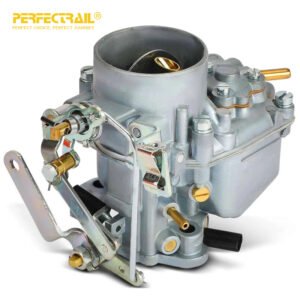
Air enters vertically from the top air horn and flows downward through the throttle plate into the manifold. Downdraft designs use gravity to assist fuel mist delivery. They are the standard configuration on classic Land Rover four-cylinder engines, including the Zenith 36IV and Weber 34ICH.
2. Sidedraft and Horizontal Draft Carburetors
Air flows horizontally across the engine cylinder head. Sidedraft carburetors provide a straight, unrestricted intake path without 90-degree bends. They offer excellent hood clearance and high-RPM breathing, widely used on British performance engines including twin SU installations.
Fixed-Venturi vs. Constant-Depression (Variable Venturi) Systems
The mechanism governing venturi throat size represents the fundamental divide in classic British automotive carburation:
1. Fixed-Venturi Carburetors (Zenith, Weber, Solex)
Fixed-venturi carburetors feature cast, non-moving venturi throats. As engine speed rises, air velocity and vacuum increase proportionally. Because throat geometry is fixed, the unit relies on separate idle, progression, main, and power circuits with distinct brass jets to cover different RPM bands. They provide crisp throttle response and simple mechanical tuning.
2. Constant-Depression / Variable-Venturi (Zenith-Stromberg CD, SU)
Constant-depression (CV) carburetors maintain constant air velocity and vacuum across the fuel jet. A vacuum-actuated piston or rubber diaphragm moves vertically in response to engine load. As the piston rises, it enlarges the venturi throat area while lifting a precision-tapered metering needle out of a fixed fuel jet orifice.
An internal hydraulic oil damper inside the piston guide rod slows piston ascent during rapid throttle opening. This momentary lag creates a rich acceleration mixture without requiring a separate mechanical accelerator pump. Constant-depression carburetors provide exceptionally smooth torque delivery across wide RPM bands.
3. Zenith 36IV vs. Weber 34ICH Flow Characteristics
Restorers frequently debate between factory Zenith 36IV and aftermarket Weber 34ICH carburetors. The Zenith 36IV uses an annular discharge nozzle that delivers exceptional low-RPM crawl torque. This low-speed torque is ideal for technical off-road driving.
In contrast, the Weber 34ICH features a modern die-cast aluminium body and replaceable brass air bleeds. It resists thermal warping effectively and provides superior mid-range fuel economy. Modern precision-cast replacement carburetors combine the low-end torque of original designs with modern manufacturing durability.
4. Stromberg 175CD Temperature Compensator & Bypass Valves
Zenith-Stromberg 175CD carburetors feature a bi-metallic temperature compensator valve on the side of the casting. As under-hood engine bay temperatures rise, the bi-metallic strip bends. This action bleeds extra air around the venturi into the manifold.
This supplemental air leans out hot idle fuel mixtures, preventing engine loading and black smoke during summer traffic jams. The assembly also incorporates a deceleration bypass valve to eliminate exhaust popping when shifting gears.
Key Technical Specifications Comparison
The table below details technical specifications for major carburetor models found in classic Land Rover service networks:
| Carburetor Model | Design Architecture | Bore / Venturi Size | Choke & Metering System | Primary Application Scope |
|---|---|---|---|---|
| Zenith 36IV | Single-Barrel Downdraft Fixed Venturi | 36 mm Bore / 26 mm Venturi | Manual Choke with Strangler Flap; Emulsion Tube Main Jet | Factory Original on Series IIA / III 2.25L Petrol |
| Weber 34ICH | Single-Barrel Downdraft Fixed Venturi | 34 mm Bore / 27 mm Venturi | Cable Choke; Diaphragm Accelerator Pump; Calibrated Jets | Popular Reliability Conversion for Series II/III & Defender 2.25/2.5L |
| Zenith-Stromberg 175CD / CD2S | Single-Throat Constant-Depression (CV) | 1.75 inch (44.5 mm) Throat | Rubber Diaphragm / Air Valve; Tapered Needle B2AU/B1CD | Dual Setup on Range Rover Classic 3.5L V8 & Stage 1 V8 |
| SU HIF44 / HS6 | Horizontal Constant-Depression (CV) | 1.75 inch (44.5 mm) Throat | Integral Float Chamber; Vacuum Piston & Oil Damper | Dual Setup on Defender 3.5L V8 & Late Classic Range Rover V8 |
4. Land Rover Engine Families and Carburetor Application Logic
Over five decades of carbureted Land Rover production, factory engineers paired specific carburetors with distinct petrol engine families. Navigating these application nuances ensures zero fitment comebacks for parts distributors and engine machine shops.
1. The 2.25L & 2.5L Four-Cylinder Petrol Engines
The rugged 2.25-litre (2286 cc) overhead-valve petrol engine powered hundreds of thousands of Series II, IIA, and III utility vehicles from 1958 through 1985. The engine later expanded into the 2.5-litre (2495 cc) petrol unit used in early Land Rover 90 and 110 Defender models.
Early Series II vehicles used Solex 32PBICC or Zenith 36IV downdraft carburetors. The Zenith 36IV delivers solid low-end torque but suffers from float bowl body distortion when exposed to manifold heat. The Weber 34ICH is now the worldwide standard replacement. It bolts directly to the factory two-bolt intake manifold flange using a purpose-made phenolic insulating spacer block.
Wholesalers can explore related four-cylinder and utility vehicle components via PERFECTRAIL’s dedicated Defender parts catalog.
2. The 3.5-Litre Rover V8 Powertrain
The iconic all-aluminium 3.5-litre (3528 cc) Rover V8 engine debuted in the 1970 Range Rover Classic. It subsequently powered the Land Rover Series III Stage 1 V8, the 101 Forward Control military truck, and early Defender 90/110 V8 models.
The carbureted Rover V8 employs a cross-ram dual intake manifold. Each bank of four cylinders is fed by a dedicated constant-depression carburetor. Early versions utilized twin Zenith-Stromberg 175CD units with automatic water chokes or manual pull cables. Later models transitioned to twin SU HIF44 carburetors featuring integral float chambers for improved cold starting and altitude compensation.
For complete chassis, suspension, and driveline restoration support, distributors can access the specialized Range Rover parts category.
3. Legacy Series I (1.6L & 2.0L Petrol) Platforms
Pioneering 1948–1958 Series I vehicles utilized 1.6L and 2.0L intake-over-exhaust (IOE) “spread bore” petrol engines. These historic engines rely on Solex 32PBI single-choke downdraft carburetors with oil-bath air cleaners. Rebuilding these units requires specialized float valve needles and bespoke gasket sets.
Phenolic Thermal Spacers and Vapor Lock Prevention
Classic Land Rover exhaust and intake manifolds sit close together on the cylinder head. Radiated exhaust heat transfers rapidly into the carburetor base flange. This thermal soak causes liquid petrol inside the float bowl to boil, creating fuel vapor bubbles (vapor lock).
Installing a 6 mm to 10 mm thick phenolic thermal insulating spacer between the intake manifold and carburetor base stops conductive heat transfer. This critical insulator prevents hot-start stalling and fuel percolation during hot summer driving conditions.
Military 24V FFR Dual Fuel Filter Configurations
Military Land Rover Fitted For Radio (FFR) and GS utility trucks operated in severe desert environments. These vehicles utilized secondary glass-bowl sedimenter fuel filters mounted on the bulkhead.
Restoration workshops rebuilding ex-military Series and Defender vehicles must ensure dual fuel filtration is maintained. Clean fuel prevents fine silica dust from clogging sensitive idle jets and scoring brass throttle shafts.
Application Sourcing Reference Table
| Vehicle Family | Engine Displacement & Code | Carburetor Setup | Recommended Replacement / Conversion |
|---|---|---|---|
| Series IIA / III 88 & 109 | 2.25L Petrol (8:1 / 7:1 CR) | Single Zenith 36IV (5-port/6-port) | Brand-New Zenith 36IV or Weber 34ICH Conversion Kit |
| Defender 90 / 110 (1983–1993) | 2.5L Petrol (17H Engine) | Single Weber 32/34 DMTL or 34ICH | Weber 32/34 DMTL Twin-Choke Progressive or 34ICH Kit |
| Range Rover Classic (1970–1985) | 3.5L Rover V8 (Low/High CR) | Twin Zenith-Stromberg 175CDSE | Matched Rebuilt Pair 175CD with B2AU Needles or Twin SU HIF44 |
| Series III Stage 1 V8 / 101 FC | 3.5L Rover V8 Detuned (3.5L V8) | Twin Zenith-Stromberg 175CD | Twin 175CD Set with Restrictor Plate Delete & Matched Needles |
Discover more product ranges across the Discovery parts catalog, Freelander parts catalog, and the complete Land Rover parts specialist directory.
5. Carburetor Failure Modes, Tuning Diagnostics, and Inspection
Carburetor malfunctions can mimic ignition faults, valve timing errors, fuel pump failures, or cylinder compression loss. A structured diagnostic approach allows restoration technicians to identify mechanical wear quickly and choose between localized rebuilds and complete unit replacements.
Top Carburetor Failure Modes & Forensic Evidence
Examining the carburetor assembly reveals clear root causes of engine running problems:
1. Throttle Shaft Bore Wear & False Air Leaks
Visual Evidence: Noticeable lateral play when wiggling the brass throttle shaft lever. Black carbon dusting appears around the shaft pivot holes.
Root Causes: Millions of throttle pedal movements wear the unbushed zinc alloy body oval. Unmetered air gets sucked directly into the intake manifold below the venturi, causing an uncontrollable lean idle, hanging RPM, and erratic deceleration.
2. Float Chamber Warping & Vacuum Flange Distortion
Visual Evidence: Visible gap between the upper air horn casting and the float bowl body. Fuel weeping occurs along the perimeter gasket seam.
Root Causes: Zinc die-castings warp after decades of under-hood heat exposure. Overtightening the two manifold base nuts bends the bottom mounting ears, creating massive manifold vacuum leaks.
3. Needle Valve Erosion & Fuel Flooding
Visual Evidence: Raw liquid petrol pouring out of the carburetor throat, air filter box, or bowl overflow vent onto hot exhaust components.
Root Causes: Worn needle valve tip, sunken brass float full of petrol, or debris holding the needle open. Excessive mechanical fuel pump pressure exceeding 3.5 psi overpowers the float assembly.
4. Gummed Jets & Ethanol Degradation
Visual Evidence: Greenish varnish crust or white powdery zinc oxide corrosion clogging idle jets, emulsion tube cross-drillings, and main well passages.
Root Causes: Modern E10 ethanol fuel absorbs atmospheric moisture, separating into water-ethanol phases that corrode zinc and brass during seasonal vehicle storage.
5. Constant-Depression Diaphragm Rupture (CD175)
Visual Evidence: The air valve piston fails to lift when revving the engine. Splits, pinholes, or hardening visible in the flexible nitrile rubber diaphragm.
Root Causes: Rubber dry rot, ozone cracking, or fuel solvent degradation. Loss of vacuum seal prevents the piston from rising, severely restricting top-end engine power.
Diagnostic Reading of Spark Plugs and Tailpipe Emissions
Spark plug visual inspection provides an immediate window into carburetor air-fuel calibration:
- Dry Sooty Black Carbon: Overly rich mixture. Causes include high float level, sticking choke, oversized main jet, or blocked air bleeds.
- Glazed White or Blistered Ceramic: Dangerously lean mixture. Causes include vacuum leaks, low float level, clogged main jets, or incorrect needle profile.
- Light Tan / Light Grey Insulator: Optimum air-fuel mixture. Indicates clean combustion and properly balanced idle and main circuits.
6. How B2B Buyers and Restoration Workshops Should Select Carburetors
Restoring classic Land Rover fuel systems requires structured decision-making. Engine rebuilders must evaluate whether to overhaul an existing original carburetor or install a brand-new complete replacement assembly.
Evaluating Rebuild Kits vs. Complete Carburetor Replacement
Follow these technical criteria when recommending overhaul solutions to workshop customers:
- Select a Minor Gasket & Seal Kit: Recommended when the original casting is flat, throttle shaft play is under 0.10 mm, and the vehicle only suffers from minor fuel weeping or degraded gaskets.
- Select a Master Overhaul Kit: Recommended when jets, emulsion tubes, float needle, power valve, and accelerator pump diaphragm require full renewal.
- Select a Complete Brand-New Assembly: Mandatory when throttle shaft bores are worn oval, the main base flange is bowed over 0.25 mm, internal zinc fuel passages are corroded, or missing original parts make restoration uneconomic.
Precision Tuning and Synchronization for Dual V8 Carburetors
Tuning twin Zenith-Stromberg or twin SU carburetors on a 3.5L Rover V8 requires synchronized calibration:
- Disconnect Throttle Interconnecting Linkage: Loosen the clamping bolts on the center throttle linkage rod. Ensure both throttle plates seat fully against their idle stop screws independently.
- Balance Airflow Using a Synchrometer: Place a flow synchrometer gauge over each carburetor intake horn. Adjust idle stop screws until both barrels draw identical CFM airflow at 750 RPM.
- Adjust Idle Mixture and Piston Lift: Adjust mixture trim screws or jet adjusting nuts. Lift the damper piston 1 mm using a lift pin; engine speed should momentarily rise slightly and stabilize without stalling.
- Top Up Damper Reservoir Oil: Fill the hydraulic damper dashpot reservoir with SAE 20W non-detergent motor oil or specialized SU/Stromberg damper fluid to ensure smooth acceleration enrichment.
Float Height Measurement Procedures & Tooling
Setting float height is an exact measurement process. Invert the carburetor upper body with the float resting on the spring-loaded needle valve. Do not compress the tiny internal needle spring during measurement.
Use digital vernier calipers or a dedicated stepped float gauge. Measure distance from the machined gasket face to the lowest edge of the float pontoon. Adjust float height by gently bending the brass tang with small pliers until factory tolerance (±0.5 mm) is achieved.
Baseline Jetting Calibration for High-Altitude Operations
Classic Land Rovers operating above 1,500 meters (5,000 feet) experience lower atmospheric air density. Standard sea-level main jets deliver overly rich mixtures at high altitudes, resulting in black smoke and lost power.
Restoration workshops should reduce main jet size by approximately 2% to 3% for every 1,000 meters of elevation gain. Providing auxiliary jetting assortments with wholesale orders allows international customers to tailor air-fuel ratios perfectly for mountain territories.
B2B Sourcing Specification Checklist
- Engine displacement (2.25L Petrol, 2.5L Petrol, 3.5L V8) and compression ratio (7:1 or 8:1) verified.
- Manifold mounting stud center-to-center distance measured and verified.
- Throttle linkage ball-joint orientation and return spring bracket style checked.
- Choke cable pull bracket and cold start enrichment mechanism confirmed.
- Fuel inlet hose barb diameter (typically 8 mm / 5/16 inch) and fuel return port configuration specified.
7. Quality Assurance, and Precision Flow Bench Testing
Under Google’s E-E-A-T guidelines (Experience, Expertise, Authoritativeness, and Trustworthiness), automotive technical content must reflect verifiable manufacturing discipline. Precision carburetor production demands tight dimensional tolerances, premium metallurgy, and strict fluid flow testing.
Manufacturing Standards & Metrology Verification
High-grade carburetor manufacturing adheres to ISO 9001 and IATF 16949 certified production controls:
- High-Density Zinc Die-Casting: Modern zinc alloy bodies use high-pressure die-casting to eliminate internal porosity, pinholes, and micro-cracks that cause vacuum leaks.
- CNC Flange Milling: Throttle base flanges and float bowl mating faces are precision CNC-milled to guaranteed flatness within 0.03 mm.
- Bushed Throttle Shafts: Premium replacement carburetors incorporate self-lubricating bronze shaft bushings to prevent future throttle bore ovality wear.
- Calibrated Flow Bench Calibration: Every production batch is 100% flow-tested on automated test benches. Liquid flow rates through idle and main circuits are verified across standard pressure drops.
Ethanol Compatibility & Viton Sealing Technology
Modern pump fuels contain 5% to 10% ethanol (E5/E10), which degrades vintage natural rubber and cork gaskets. Quality replacement carburetors use 100% genuine Viton (FKM) needle valve tips, nitrile-reinforced pump diaphragms, and synthetic composite bowl gaskets. These materials resist ethanol swelling and guarantee leak-free operation.
Ultrasonic Vacuum Leak Detection Protocols
Post-machining quality control requires pressurized air and vacuum decay testing. Automated pneumatic test fixtures seal the carburetor base and air horn. A controlled vacuum of -0.5 bar is applied across the throttle plate.
Ultrasonic sensors detect minute air leaks around throttle shaft bushings and gasket seams. Rejecting assemblies with micro-porosity guarantees that every shipped unit maintains a rock-solid idle out of the box.
Automated Air-Fuel Ratio Flow Bench Calibration
Every production batch undergoes airflow validation on computer-controlled wet flow benches. Specialized calibration fluid with standard viscosity simulates petrol density safely. Test fixtures measure exact liquid discharge across idle, progression, and wide-open throttle states.
Calibrated flow testing ensures both barrels of dual V8 setups flow within ±1.5% of each other. This tight tolerance eliminates rough running and simplifies final workshop synchronization on customer vehicles.
8. Wholesale Inventory Planning, Kitting Strategies, and Logistics
Restoration workshops operate under demanding project schedules. Parts distributors and catalog wholesalers must balance stock availability between complete ready-to-bolt-on carburetors, fast-moving service kits, and specialized individual replacement parts.
ABC Inventory Categorization for Classic Fuel Systems
- Category A (High-Turnover Fast Movers): Brand-new Zenith 36IV and Weber 34ICH conversion carburetors for Series IIA/III 2.25L engines. Maintain 60–90 days of safety stock for immediate dispatch.
- Category B (Medium Turnover): Complete master rebuild kits for Zenith 36IV, Stromberg 175CD, and SU HIF44; replacement floats and fuel cutoff needles. Automatic reorder triggers based on weekly sales velocity.
- Category C (Specialist Restorations): Matched pairs of brand-new V8 carburetors, specialized Weber 32/34 DMTL progressive conversions, and vintage Solex overhaul kits on 15–30 day lead times.
High-Margin Rebuild Bundling & Kitting Strategies
Wholesalers can substantially boost average order value (AOV) by offering bundled classic fuel system packages:
| Package Solution | Included Component Scope | Target Customer & Workshop Value |
|---|---|---|
| Turnkey Bolt-On Carburetor Kit | Brand-New Carburetor + Phenolic Spacer + Manifold Gaskets + Fuel Filter + Choke Cable Linkage | Direct replacement for Series II/III; enables 60-minute workshop installation with zero parts chasing. |
| Complete Master Overhaul Pack | Viton Needle & Seat + Nitrophyl Float + All Gaskets + Diaphragms + Main/Idle Jets + Throttle Return Springs | Standard bench rebuild package for classic vehicle restorers preserving original matching-numbers castings. |
| Total Fuel Delivery System Bundle | New Carburetor + Mechanical Glass-Bowl Fuel Pump + In-Line Fuel Pressure Regulator + Fuel Sender Unit | Comprehensive frame-off restoration kit; guarantees factory fuel pressure (2.5–3.5 psi) and prevents flooding. |
Export Packaging & Maritime Logistics Execution
Carburetors contain delicate internal linkages, needle valves, and calibrated springs. PERFECTRAIL implements strict export packaging protocols. Each unit is wrapped in anti-static VCI anti-corrosion barrier film, nestled in custom foam-molded internal cartons with protective port plugs, and packed into master shipping cartons strapped to export pallets.
Safety Stock Calculations for Specialist Wholesalers
Classic restoration shops experience seasonal demand peaks during spring and summer rebuild seasons. Parts distributors should maintain minimum 60-day safety stock levels for fast-moving Zenith 36IV and Weber 34ICH units.
Master rebuild gasket kits and float needles should be stocked in ratios of 3:1 relative to complete assemblies. This inventory balance meets demand for both routine maintenance and full engine overhauls.
Mixed-Pallet Shipping Optimization
Carburetors feature dense mass and compact packaging dimensions. Importers can combine carburetor cartons on mixed pallets with lighter Land Rover body rubbers, lenses, or suspension bushings.
Consolidated pallet shipping maximizes sea container cubic volume utilization. This logistics approach reduces average landed freight costs per part substantially for overseas trade buyers.
Visual SEO & Multimodal Search Optimization
To maximize visual search traffic across Google Images and B2B procurement portals, product listings should feature high-resolution photography with optimized alt attributes:
alt="Classic Land Rover Series 3 Zenith 36IV replacement carburetor assembly"alt="Weber 34ICH conversion kit for Land Rover Defender 2.25L petrol engine"alt="Twin Zenith-Stromberg 175CD carburetors on Range Rover Classic 3.5L V8"alt="Exploded diagram of automotive carburetor showing float chamber, venturi, and idle jets"
9. Frequently Asked Questions for Engine Rebuilders & Wholesalers
What does an automotive carburetor do in classic Land Rover engines?
A carburetor mixes incoming air with atomized liquid fuel in precise stoichiometric ratios. It regulates engine speed via throttle plates and draws fuel using the Bernoulli venturi vacuum effect.
What are the most common carburetor types used on vintage Land Rovers?
Vintage Land Rovers commonly use single-barrel downdraft carburetors like the Zenith 36IV and Weber 34ICH on four-cylinder engines. Dual Zenith-Stromberg CD175 or twin SU HIF44 carburetors power classic 3.5L Rover V8 engines.
What are the primary symptoms of a failing or worn carburetor?
Primary symptoms include rough idling, engine stalling, black exhaust smoke from rich mixtures, lean backfiring under acceleration, hard starting, fuel flooding, and strong petrol odors.
Why do vintage Zenith 36IV carburetors suffer from fuel leaks and warping?
Zenith 36IV zinc-alloy die-cast bodies warp over decades of engine heat cycles. Overtightened mounting bolts bend the base flange, causing vacuum leaks and float bowl fuel weeping.
What is the difference between fixed-venturi and constant-depression (CV) carburetors?
Fixed-venturi carburetors like Weber and Zenith use stationary venturi throats with multiple metered fuel circuits. Constant-depression carburetors like Zenith-Stromberg and SU use a vacuum-actuated piston and tapered needle to vary throat area dynamically.
How should engine rebuilders select between carburetor rebuild kits and complete assemblies?
Choose minor rebuild kits for routine gasket, needle, and diaphragm servicing. Choose complete replacement assemblies if throttle shaft bores are worn oval, castings are warped, or internal fuel passages are corroded.
Does PERFECTRAIL supply classic Land Rover carburetors and repair kits for wholesale?
Yes. PERFECTRAIL supplies brand-new carburetor assemblies, rebuild kits, floats, jets, and fuel pumps for Land Rover Series I/II/III, Defender, and Range Rover Classic with low MOQ and worldwide delivery.
What specifications should be verified before ordering classic Land Rover carburetors?
Verify the engine displacement (2.25L, 2.5L, 3.5L V8), manifold mounting stud spacing, throttle linkage orientation, manual vs. automatic choke configuration, main jet size, and fuel inlet fitting type.
10. Conclusion: Building a Reliable Classic Land Rover Carburetor Supply Program
Automotive carburetors represent an enduring mechanical art form. Operating under Bernoulli fluid dynamics, these precision metering devices deliver dependable fuel-air mixtures across all terrain conditions. In classic Land Rover Series, Defender, and Range Rover Classic platforms, reliable carburation is fundamental to engine health, cold-weather starting, and off-road driving pleasure.
Strategic Procurement for Restoration Specialists
For vintage parts distributors, classic car restoration centers, and specialist engine rebuilders, partnering with a dedicated supplier eliminates casting distortion and fuel leak comebacks. Distributors who stock ready-to-run Zenith 36IV and Weber 34ICH carburetors alongside comprehensive overhaul kits build loyal, high-margin trade relationships.
Restoration success requires systematic quality assurance. Workshops must inspect throttle shaft play, verify manifold base flatness, and calibrate float heights. Always installing new fuel filters and ethanol-resistant needle valves ensures smooth, long-term engine performance.
Preserving Heritage Performance with Modern Durability
Vintage off-road vehicles demand mechanical authenticity combined with modern material longevity. Precision-machined replacement carburetors preserve classic engine bay appearance while eliminating original zinc porosity issues.
Modern CNC-machined base flanges and Viton-tipped needle valves withstand modern ethanol fuel blends reliably. This metallurgical upgrade guarantees dependable off-road operation across remote trail expeditions worldwide.
Partnering with PERFECTRAIL for Global Wholesale
PERFECTRAIL supports worldwide businesses as a premier China-based Land Rover genuine and aftermarket parts specialist. Supported by 15+ years of export experience and 250,000+ parts references, PERFECTRAIL offers low MOQ policies, fast stock dispatch, custom packaging, and a full 12-month warranty to accelerate your business growth.
Request a Classic Land Rover Carburetor Wholesale Quote
Partner with China’s leading Land Rover parts specialist. Send your vehicle models (Series I/II/III, Defender, Range Rover Classic), engine codes (2.25L, 2.5L, 3.5L V8), required carburetor types (Zenith 36IV, Weber 34ICH, Stromberg 175CD), and target quantities to receive a competitive factory-direct wholesale quotation within 12 hours.
Land Rover Parts Specialists | OEM & Premium Aftermarket | 12-Month Warranty | Low MOQ
Suggested Visual SEO Assets: Exploded technical diagram of Zenith 36IV carburetor showing float chamber, venturi throat, and emulsion tubes; Cross-section illustration of Bernoulli venturi airflow and fuel atomization; Step-by-step float height measurement using digital calipers; Dual Zenith-Stromberg CD175 synchronization setup on Rover 3.5L V8 intake manifold; Precision foam-molded export packaging for complete carburetor assemblies.
Recommended Image Alt Text: “Classic Land Rover Series 3 Zenith 36IV replacement carburetor assembly”; “Weber 34ICH conversion kit for Land Rover Defender 2.25L petrol engine”; “Twin Zenith-Stromberg 175CD carburetors on Range Rover Classic 3.5L V8”; “Exploded diagram of automotive carburetor showing float chamber, venturi, and idle jets.”