The Ultimate B2B Guide to Land Rover Oil Pumps: Lubrication, Reliability, Fitment, and Wholesale Sourcing
The lede: An engine oil pump is a quiet component with a decisive job: it moves lubricant from the sump through the galleries that protect bearings, camshafts, turbocharger components, timing parts, piston cooling systems, and other moving surfaces. For B2B Land Rover parts buyers, selecting an oil pump is not simply a matter of matching a photograph. The correct replacement must deliver the intended pressure and flow, fit the exact engine configuration, work with the pickup and relief-valve system, and arrive with commercial support that protects workshop uptime.
This guide explains how automotive oil pumps work, how pressure differs from volume, how gear and gerotor designs are selected, why pickup screens and priming matter, how technicians diagnose low oil pressure, and how importers and distributors can build an efficient Land Rover oil-pump sourcing program. PERFECTRAIL is described only through capabilities presented on its public website: Land Rover specialization, OEM and aftermarket replacement parts, product consultation, low-MOQ support, stock and global delivery, OEM/ODM assistance, supplier evaluation, product inspection, and a published warranty program. Exact application, OE reference, availability, and commercial terms must be verified for every enquiry.
1. Global B2B Market Opportunity for Land Rover Oil Pumps
The Land Rover aftermarket combines premium vehicle values with a wide range of vehicle ages and engine technologies. This creates recurring demand for internal engine parts, especially when vehicles move outside the original dealer network and independent workshops become responsible for maintenance, repair, and engine rebuilding. An oil pump is a particularly important SKU because it is often replaced during an engine overhaul, after an oil-pressure incident, or when internal wear has made the original pump unreliable.
A B2B buyer is not purchasing only a metal housing and a rotor set. The buyer is purchasing lubrication-system confidence. If the pump is wrong, unavailable, poorly packed, or incorrectly matched to the engine, the workshop may lose days while the engine remains open. If the pump fails after installation, the consequences can include bearing damage, camshaft wear, turbocharger damage, or a repeat rebuild. These risks explain why technical information and application confirmation should appear beside the price in a professional wholesale offer.
The commercial opportunity is also connected to related parts. An oil pump normally works with an oil pickup tube or screen, sump gasket, pressure-relief valve, seals, oil filter, engine oil, and sometimes a drive gear, intermediate shaft, chain, or timing-cover assembly. A supplier that can help a workshop identify the complete repair scope can increase average order value while reducing the chance that a new pump is installed in a contaminated or damaged lubrication system.
Why oil-pump sourcing is a high-consequence purchase
Many exterior parts can be assessed visually. Oil-pump suitability is more technical. A pump may have a similar shape but a different mounting pattern, drive arrangement, rotor geometry, relief-valve calibration, pickup position, or flow characteristic. A pump designed for a different engine can physically fit only after modification, yet still deliver an unsuitable lubrication performance. For a distributor, an apparently inexpensive wrong part can generate return freight, technical disputes, workshop dissatisfaction, and lost repeat business.
This is why search-focused content should address both informational and commercial intent. A workshop may search for “what does an oil pump do,” while a procurement manager may search for “Land Rover oil pump supplier,” “aftermarket oil pump wholesale,” “oil pump low pressure symptoms,” or “oil pump OE cross reference.” A useful B2B article answers the first question, then guides the reader toward the second without using exaggerated fitment claims.
PERFECTRAIL’s relevant B2B positioning
PERFECTRAIL’s public website presents the company as a Land Rover parts specialist offering OEM and aftermarket parts across core Land Rover vehicle families. Its published business information highlights product consultation, stock, low MOQ, global delivery, OEM/ODM support, supplier evaluation, product inspection, and after-sales service. These points are useful trust signals for an oil-pump landing page because buyers need help with application data, mixed-SKU purchasing, quality questions, and replenishment.
B2B takeaway: Position a Land Rover oil pump as a precision lubrication component and a business-risk decision. The strongest offer combines verified fitment, application support, clear inspection information, practical logistics, and a transparent warranty process.
2. How an Engine Oil Pump Works
The engine oil pump creates the movement that carries lubricant from the sump to the engine’s oil galleries. The sump, sometimes called the oil pan, acts as the reservoir. The pickup tube and screen draw oil from the reservoir. The pump then moves oil into the pressurized side of the lubrication circuit, where passages distribute it to bearings, journals, valve-train components, timing mechanisms, piston cooling jets, turbocharger bearings, and other areas specified by the engine design.
The oil pump does not create lubrication on its own. It creates the flow and pressure needed to maintain an oil film between moving surfaces. The engine’s clearances, oil viscosity, temperature, filter restriction, gallery design, relief-valve setting, and component wear all influence the final pressure observed at a gauge. A healthy pump installed in an engine with excessive bearing clearance may not restore normal pressure, just as a new filter cannot compensate for a damaged pump drive.
Positive-displacement pumping
Most automotive engine oil pumps are positive-displacement pumps. Their gears or rotors trap a defined volume of oil and carry it from the inlet to the outlet. As engine speed rises, the pump generally turns faster and can move more oil. The engine does not need unlimited pressure, so a pressure-relief valve protects the circuit when resistance or flow demand creates excessive pressure.
The relief valve is a critical part of the system. If it is stuck open because of debris, pressure may fall. If it is stuck closed or incorrectly calibrated, excessive pressure may stress seals, filters, housings, or other components. The valve should therefore be inspected as part of a pump diagnosis, rather than treated as an unrelated small component.
Oil pressure versus oil flow
Pressure is resistance to flow; flow is the amount of lubricant moved over time. The two are related but not interchangeable. A pump can produce high pressure against a restriction while delivering insufficient volume through a damaged or poorly designed circuit. Conversely, a high-volume pump may move more oil without automatically producing higher pressure in an engine with open clearances or an unsuitable relief-valve arrangement.
This distinction is essential for B2B buyers because “high pressure” and “high volume” are not generic upgrades. A stock engine normally requires the pump specification selected by its designer. A modified engine with increased bearing clearances, higher operating speed, external coolers, or additional oil demand may require a different solution, but the decision should come from measured requirements and the applicable technical specification.
Technical caution: Never recommend a high-volume or high-pressure oil pump solely because the label sounds stronger. The correct pump must match the engine’s clearances, drive system, relief-valve behavior, oil circuit, and intended operating conditions.
3. Oil Pump Types, Pressure, and Flow
Automotive oil pumps are designed around the engine’s space, drive arrangement, pressure requirement, flow requirement, noise target, manufacturing cost, and service environment. The most common families discussed by engine builders are gear pumps and gerotor pumps. Some specialist engines also use Roots-style scavenging stages, multi-stage dry-sump systems, or electrically driven auxiliary pumps. A Land Rover replacement application normally requires the exact original-style architecture unless the engine has been intentionally modified.
Gear oil pumps
A gear pump uses meshing gears to trap oil at the inlet and move it toward the outlet. Gear designs are robust, familiar to engine builders, and capable of delivering a stable pressure flow when their clearances and housing are correctly controlled. The gears, end plate, body, shaft, and relief valve all contribute to performance. Wear on the end plate or housing can create internal leakage and reduce effective output even when the pump still turns.
The buyer should ask whether the gear profile, shaft drive, housing dimensions, relief-valve setting, and pickup interface match the target engine. A visually similar gear pump can have a different displacement per revolution. That difference may not be obvious until the engine reaches operating temperature, high load, or low idle speed.
Gerotor oil pumps
A gerotor pump uses an inner rotor and an outer rotor with a different number of lobes. Their eccentric relationship creates expanding and contracting chambers that draw in and discharge oil. Gerotor assemblies can be compact and efficient, which makes them useful where the engine package has limited space. They are also sensitive to rotor clearance, housing condition, contamination, and correct assembly.
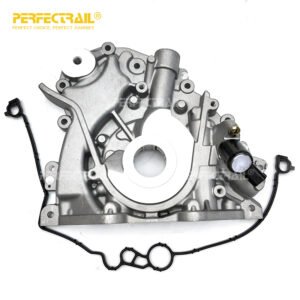
For a gerotor replacement, inspect the inner rotor, outer rotor, cover or housing, drive tang, relief valve, and seal surfaces as a complete system. If the original housing is worn, installing new rotors alone may not restore the intended clearances. A supplier should make clear whether the quotation is for a complete pump assembly, a rotor kit, a repair kit, or a pump that relies on a reusable original cover.
Wet-sump and dry-sump concepts
In a conventional wet-sump engine, the sump stores oil and the pump sends it through the pressure circuit before it returns to the sump. A dry-sump system uses a separate reservoir and may use one or more scavenge stages to remove oil and air from the sump. Dry-sump designs are more common in specialist performance, racing, or unusual packaging applications than in ordinary passenger vehicles. They demonstrate why oil pump selection must follow the engine’s complete lubrication architecture.
Scavenge pumps prioritize volume and the handling of oil mixed with air, while pressure pumps prioritize controlled delivery to the engine galleries. This difference is useful technical context for a B2B article, but it should not be used to suggest that a racing multi-stage pump is a drop-in choice for a standard Land Rover engine. The correct product is determined by the application, not by the most impressive specification on a catalogue page.
| Pump category | Typical design strength | B2B verification point |
|---|---|---|
| Gear pump | Robust positive displacement and stable pressure delivery | Gear size, shaft drive, housing, end plate, relief valve |
| Gerotor pump | Compact packaging and efficient rotor action | Rotor pair, cover clearance, drive, seal, housing condition |
| High-volume pump | More flow for a documented increase in oil demand | Engine clearances, speed, oil circuit, and relief behavior |
| High-pressure pump | Higher pressure threshold at selected operating conditions | Correct pressure specification, not simply a larger number |
4. Land Rover Fitment and Application Verification
A Land Rover model name is not enough to identify an oil pump. Defender, Range Rover, Discovery, and Freelander each cover multiple generations and engine configurations. The engine may differ by displacement, fuel type, cylinder layout, turbocharging, emissions market, production year, lubrication-system packaging, and timing or drive arrangement. A correct B2B buying process must therefore move from model-family intent to exact application verification.
The minimum fitment record
Ask the buyer for the VIN, engine code, model year, fuel type, OE number, oil-pump position or assembly description, and photographs of the original part where available. If the engine has been rebuilt, modified, or replaced, record that information too. A replacement engine can make the registration details different from the actual oil-pump application.
Cross-reference numbers are useful but should not be treated as automatic proof of interchangeability. A number may have been superseded, may apply to one market, or may be listed by multiple aftermarket brands with different packaging. The supplier should confirm the actual application and identify whether the part is a complete pump, a pump-and-pickup assembly, or a service kit.
Related components that can change the order
The oil-pump assembly may work with a pickup tube, mesh screen, gasket, seal, drive gear, chain, intermediate shaft, pressure-relief valve, sump, oil filter, or timing cover. A contaminated pickup can starve a new pump. A worn drive gear can prevent reliable rotation. A damaged cover can create excess internal leakage. For these reasons, a B2B quotation should ask whether the customer needs the pump alone or a complete lubrication-system repair package.
SEO and internal-link structure
A well-structured Oil Pump page can link to PERFECTRAIL’s Land Rover parts specialist overview, the Defender parts category, the Range Rover parts category, the Discovery parts category, and the contact page. Use descriptive anchor text and place each link where it helps the reader move from technical education to fitment or enquiry.
Do not claim that one oil pump fits every vehicle in a family. Instead, use wording such as “for selected Land Rover applications; confirm by VIN and OE number.” This protects the user and improves content quality because the page explains the real purchasing condition rather than promising an unsupported universal result.
5. Oil Pump Failure Symptoms and Professional Diagnosis
Oil-pump problems are frequently discovered through a low-oil-pressure warning, an unusual engine noise, or damage found during an engine rebuild. The important diagnostic principle is that low oil pressure does not automatically prove the pump is defective. Low oil level, incorrect oil viscosity, a blocked pickup screen, a damaged relief valve, excessive bearing clearance, a worn drive, a leaking filter seal, a faulty pressure sensor, or a cracked oil passage can create similar symptoms.
Common symptoms associated with lubrication-system faults
- Oil-pressure warning: A warning lamp or message should be treated seriously, especially if it remains on after start-up or appears when the engine is warm.
- Top-end ticking: Camshafts, followers, hydraulic lash adjusters, and other upper-engine parts may become noisy when oil supply is inadequate.
- Deep bearing noise: A heavy knock can indicate loss of the oil film at a main or connecting-rod bearing and requires immediate inspection.
- Rising engine temperature: Lubricant also carries heat away from selected components. An oil-system fault can contribute to thermal stress, although coolant and cooling-system faults must also be checked.
- Metal contamination: Particles in the oil or filter may indicate internal wear. Replacing the pump without cleaning the system can damage the new unit.
- Pressure that changes abnormally with temperature: Oil becomes thinner as it warms, so a worn engine or weak pump may show a larger pressure drop at hot idle.
A professional diagnostic sequence
- Confirm the warning. Check oil level, visible leaks, oil condition, service history, and the correct specification before dismantling components.
- Verify pressure with a mechanical gauge. A sensor or wiring fault can create a false warning; the gauge test should follow the applicable service procedure.
- Check pressure at relevant conditions. Record cold start, warm idle, and operating-speed readings where the manufacturer’s specifications allow comparison.
- Inspect the pickup and screen. Sludge, sealant, metal fragments, or a cracked pickup can restrict the pump inlet.
- Inspect the relief valve. A stuck-open valve can bypass oil and reduce pressure; a stuck or incorrect valve can create excessive pressure.
- Inspect the drive system. Check the gear, chain, shaft, coupling, or timing-cover drive arrangement for wear and correct engagement.
- Measure engine clearances. Excessive bearing or camshaft clearance can consume pressure even when pump output is acceptable.
- Find and remove contamination. Clean the sump, galleries, pickup, filter housing, and affected parts before installing a replacement pump.
Workshop warning: Do not continue operating an engine with an active low-oil-pressure warning until the cause has been investigated. A short period of running without an adequate oil film can turn a pump-related repair into a full engine rebuild.
For B2B content, this section is valuable because it captures symptom-related searches while demonstrating technical restraint. It tells readers what to check without pretending that a remote article can diagnose a specific Land Rover. It also gives sales teams a useful conversation framework when a buyer says, “My engine has low oil pressure; which pump should I order?”
6. How B2B Buyers Should Select a Replacement Oil Pump
A reliable purchasing process begins with technical application data and finishes with commercial confirmation. Buyers should compare the complete cost of a dependable replacement against the cost of an unverified unit that causes a return or repeat repair. For an oil pump, quality is not only about the pump body. It includes rotor or gear precision, clearances, pressure-relief behavior, drive compatibility, pickup interface, seals, inspection, packaging, and after-sales support.
Step one: identify the engine precisely
Send the supplier the VIN, model, production year, engine code, fuel type, OE reference, and a clear description of the requested component. If the engine has been replaced, tuned, or rebuilt, state that information. Ask whether the pump is intended for a standard replacement application, a rebuilt engine with measured clearance changes, or a modified performance application.
Step two: define what the quotation includes
Clarify whether the price covers the complete oil pump, cover, gears or rotors, relief valve, pickup tube, screen, gasket, seal, drive gear, chain, or installation hardware. A low unit price can be misleading if essential parts must be purchased separately. For a distributor, a clear bill of materials also makes it easier to create correct customer listings and avoid missing-part complaints.
Step three: decide between stock, high volume, and high pressure
Stock-volume replacement is normally the safest choice when the engine remains close to its original specification. High-volume pumps may be considered where measured bearing clearances, higher engine speed, external oil circuits, forced induction, or other modifications increase oil demand. High-pressure designs may change relief-valve behavior rather than simply adding lubricant everywhere. The supplier and qualified engine builder should agree on the intended use before the buyer confirms the SKU.
Step four: evaluate quality evidence
Ask about dimensional control, material specification, pressure and flow testing, relief-valve inspection, cleanliness, packaging, traceability, and warranty. PERFECTRAIL’s website describes supplier evaluation and product inspection for its Land Rover parts business. The specific documents available for an Oil Pump order should be requested and confirmed rather than assumed.
B2B pre-order checklist
- Have VIN, engine code, OE number, and market specification been confirmed?
- Is the quotation for a complete pump or a partial repair kit?
- Does the pickup tube or screen need replacement?
- Are the engine’s oil clearances and operating conditions known?
- What are the MOQ, price breaks, stock status, lead time, and Incoterms?
- What inspection, warranty, claim, and replacement procedures apply?
7. Quality Assurance, and Testing
Automotive quality content must help the buyer make a safer, more informed decision. Google’s E-E-A-T principles are particularly relevant for engine lubrication because readers may use the page to select a high-consequence replacement part. A credible page should explain how the component works, acknowledge diagnostic limits, identify the information needed for fitment, and connect commercial claims to evidence that the supplier can actually provide.
A practical oil-pump quality system starts before production. Raw materials, castings, machined housings, gears, rotors, shafts, springs, valves, seals, and screens must be controlled according to the approved specification. During production, dimensional checks should focus on the pump cavity, gear or rotor clearances, shaft fit, mounting face, oil passages, pickup connection, and relief-valve components. After assembly, the pump should be cleaned, protected, and inspected before packing.
Pressure and flow testing
A test that checks only whether the pump turns is not enough. A useful test setup evaluates pressure and flow under defined conditions that represent the intended application. Test oil temperature, rotational speed, viscosity, inlet condition, outlet restriction, relief-valve behavior, and measurement accuracy can all influence the result. Buyers should ask which conditions apply and whether the report belongs to the same part number or batch as the shipment.
The test result should not be copied into a product listing as a universal promise if the engine application has different operating conditions. Instead, publish the test method where approved, then state that final performance depends on the complete engine lubrication system. This wording is both more technically accurate and more trustworthy than an unsupported claim such as “guaranteed maximum oil pressure.”
Cleanliness and contamination control
Oil pumps are directly exposed to lubrication-system contamination. Chips, sealant, sludge, bearing material, and damaged screen fragments can score gears or rotors and interfere with a pressure-relief valve. A supplier should protect the pump during production and transport, while the installer must clean the sump and galleries, renew the filter, inspect the pickup, and prime the lubrication circuit according to the applicable repair procedure.
Packaging as a quality-control step
The housing and mounting face should be protected from impact, while gears, rotors, shafts, and sealing surfaces should be protected from moisture and abrasion. A rigid internal support, corrosion protection where suitable, part identification, batch information where available, and a strong outer carton reduce the risk of transit damage. For sea freight, packaging should be selected for the expected transit duration and handling environment.
Warranty and technical support
Warranty terms should state the coverage period, evidence required, installation conditions, excluded causes, and claim procedure. PERFECTRAIL’s public website describes a 12-month warranty for its parts program, together with after-sales support. The exact warranty application for a particular oil-pump order should be confirmed in writing before payment. A clear process protects both the buyer and supplier when a workshop reports low pressure after installation.
8. Wholesale Inventory, Packaging, and Global Logistics
Oil pumps are valuable engine components, but they are not normally as fast-moving as filters, belts, or brake parts. A distributor should therefore use a tiered inventory strategy. Keep confirmed high-demand references in core stock, hold medium-demand references in planned stock, and source rare or engine-specific references after VIN and OE verification. This approach limits dead capital while protecting workshop lead times on the parts that matter most.
Core, planned, and special-order stock
- Core stock: confirmed references with recurring orders and reliable local demand.
- Planned stock: references purchased with related engine parts for scheduled workshop or distributor demand.
- Special order: rare applications purchased only after application data and customer commitment are confirmed.
PERFECTRAIL publicly describes a wide Land Rover parts range, stock, low MOQ, fragmented-order support, and global delivery. For an Oil Pump buyer, this creates the possibility of combining a small trial quantity with other engine, chassis, or body SKUs instead of filling a shipment with one slow-moving reference. The actual mixed-order plan, packaging, and freight cost should be quoted according to destination and quantity.
Reducing returns and wrong-part risk
Create an internal order field for VIN, engine code, OE number, confirmed application, and technical notes. Do not release a high-risk oil-pump order while fitment is still uncertain. Store the customer’s information alongside the purchase order and packing list so that the same reference is used by purchasing, inspection, shipping, sales, and after-sales teams. This simple discipline prevents many mistakes caused by copying a shortened product name.
Build a lubrication-system bundle
A workshop may need an oil pump, pickup screen, sump gasket, filter, seal, timing cover gasket, drive component, and cleaning or priming support. A verified bundle can increase order value and reduce the time the workshop spends coordinating several suppliers. However, the bundle must be application-specific. State which items are included, which are optional, and which require separate VIN confirmation.
Shipping and documentation
A professional shipping file should identify the part number, quantity, country of origin where required, packaging, invoice information, and agreed commercial terms. The outer carton should protect the pump from impact and moisture, while internal separators should prevent the mounting face or shaft from contacting hard surfaces. Buyers should confirm whether sea, air, or consolidated freight is most appropriate for the order size and urgency.
| B2B objective | Recommended action | Commercial result |
|---|---|---|
| Protect working capital | Use core, planned, and special-order stock tiers | Reduces overstock while preserving availability |
| Reduce returns | Make VIN and OE confirmation mandatory | Lowers wrong-part freight and customer disputes |
| Increase order value | Offer verified lubrication-system bundles | Improves convenience and cross-selling |
| Protect transit quality | Use rigid, moisture-resistant internal and external packaging | Reduces damage claims and receiving delays |
Visual SEO and content assets
Use original images where possible: an oil-pump gear or gerotor close-up, an annotated lubrication-flow diagram, a pickup screen, a relief valve, a pressure-and-flow test setup, a packaging photograph, and a comparison of clean versus contaminated components. Each image should have descriptive alt text such as “Land Rover engine oil pump gerotor and housing close-up” or “engine oil pump pickup screen and lubrication flow diagram.” Avoid repeating the same keyword in every alt attribute.
The long-form page can also support downloadable fitment checklists, quotation templates, workshop inspection cards, and short technical videos. These assets should link to the Oil Pump guide and relevant Land Rover categories. The goal is to help a buyer progress from education to application confirmation and then to a quotation, not simply to add decorative media.
9. Frequently Asked Questions for Wholesalers
What does an engine oil pump do?
An oil pump moves lubricant from the sump through the engine’s oil galleries. The flow helps maintain oil films at bearings and other moving surfaces, carries heat away from selected components, and supplies the lubrication circuit at the pressure and volume required by the engine design.
What are common symptoms of a failing oil pump?
Possible symptoms include a low-oil-pressure warning, hot-idle pressure loss, ticking or tapping, deep bearing noise, unusual engine temperature, and metal contamination. These symptoms can also come from low oil level, a blocked pickup, worn bearings, a relief-valve fault, a sensor problem, or another lubrication-system issue.
Can a low oil-pressure warning prove that the pump is bad?
No. A qualified technician should verify oil level, use a mechanical pressure gauge, compare readings with the correct service information, inspect the sensor and wiring, and check the pickup, relief valve, drive, and engine clearances before ordering a replacement pump.
What is the difference between oil-pump pressure and oil-pump flow?
Flow is the amount of oil moved over time, while pressure is the resistance created by the lubrication circuit. A high-volume pump moves more oil; a high-pressure design changes pressure behavior through its specification and relief-valve arrangement. Neither is automatically correct for every engine.
Should the oil pickup screen be replaced with the pump?
The correct decision depends on the application and condition, but the pickup and screen should always be inspected. Contamination, a damaged screen, a cracked tube, or a poor seal can restrict the inlet and damage a new pump. Many professional installation plans include a new or verified pickup assembly.
How do I verify a Land Rover oil pump before ordering?
Send the supplier the VIN, engine code, model year, fuel type, OE number, and photographs or measurements of the original part. Ask whether the quote is for a complete pump, a rotor or gear kit, or a pump that requires reuse of the original cover or pickup.
Does PERFECTRAIL supply Land Rover oil pumps for wholesale buyers?
PERFECTRAIL publicly presents itself as a Land Rover parts specialist supplying OEM and aftermarket parts, including engine components, for Defender, Range Rover, Discovery, and Freelander customers. Oil-pump availability, application, MOQ, price, and lead time should be confirmed for each VIN and OE reference.
What should a wholesale oil-pump quotation include?
A useful quotation should identify the confirmed part reference, engine application, quantity, price tier, included components, stock or production status, lead time, packaging, shipping terms, inspection options, warranty, claim procedure, and quote validity. This enables the buyer to compare total landed cost and supply risk.
Does PERFECTRAIL provide support beyond the part?
The public website describes product consultation, low-MOQ service, stock, global delivery, OEM/ODM support, branding assistance, supplier evaluation, product inspection, and after-sales support. The exact service package for an Oil Pump project should be confirmed with the sales and technical teams.
10. Conclusion: Partnering for Long-Term Business Competitiveness
An oil pump is a precision lubrication component, not a generic interchangeable accessory. Its performance depends on pump architecture, gear or rotor condition, clearances, pressure-relief behavior, pickup design, oil quality, engine wear, and correct installation. For Land Rover wholesalers, the strongest sourcing decision combines verified fitment with clear technical information, inspection evidence, practical packaging, flexible order support, and transparent after-sales terms.
Before requesting a quotation, prepare the VIN, engine code, OE number, required quantity, destination market, and any workshop diagnosis. If the vehicle has low oil pressure, include the mechanical-gauge readings, oil temperature, oil grade, warning conditions, and inspection findings. This gives a specialist supplier enough information to confirm the correct application instead of guessing from a model name.
PERFECTRAIL’s public positioning as a Land Rover parts specialist, together with its OEM and aftermarket range, product consultation, low-MOQ support, global supply capabilities, OEM/ODM services, quality-control information, and warranty program, provides a relevant starting point for B2B buyers exploring oil-pump sourcing. Each specific pump must still be verified before purchase because engine configuration, drive design, and OE references determine compatibility.
After installation, the workshop should record the priming method, oil grade, filter replacement, pickup inspection, initial pressure reading, and any unusual noise during the first operating checks. For distributors, retaining this information makes warranty evaluation faster and helps separate installation or system contamination from a possible component issue. A short after-sales checklist can also reveal recurring patterns, such as a particular application needing a revised seal, a frequently damaged pickup, or a packaging improvement for long-distance shipments.
That feedback should return to purchasing and content teams. If several customers ask the same fitment question, add the answer to the product page and FAQ. If returns are caused by incomplete engine data, make VIN confirmation more prominent in the enquiry form. If workshops repeatedly order the same screen, gasket, or drive component with the pump, consider a verified bundle. This turns individual transactions into a measurable improvement loop for availability, conversion, margin protection, and customer retention.
Need a Land Rover Oil Pump Quote?
Send your VIN, engine code, OE reference, required quantity, and destination market. PERFECTRAIL can help you confirm the application and discuss wholesale supply options for Land Rover engine parts.
Land Rover parts specialist | OEM and aftermarket solutions | B2B support